In the late 1930’s independently owned retail pharmacies in the United Kingdom were finding great difficulty in competing with the emerging groups of company-owned chemist shops, and in particular with those of Boots Ltd. The Boots company had started with one small shop in Nottingham in the 1870’s, but by 1938 had over 1000 outlets throughout the nation, and were opening new shops at the rate of two or three per month.
Boots and other such groups were able to use their great buying power to obtain very favourable terms for the ingredients used in the actual compounding of medicines in the dispensary. As, at this time, almost all prescriptions were filled by a pharmacist or his assistant actually mixing the ingredients in the dispensary, the groups’ pharmacies were at a significant financial advantage. As a result, the staple income of a large number of independently owned pharmacies was under threat.
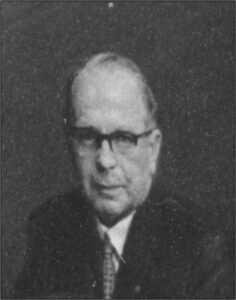
In March 1938, in order to combat this problem, Ernest Skues, a successful retail pharmacist from Tooting, in South London, sent an invitation to six of his fellow South London pharmacy proprietors to a meeting at the Charing Cross Hotel. The gathering’s purpose was to discuss what steps could be taken to redress the balance in income potential between themselves, and the pharmacy groups.
From the Minutes of this meeting, it can be seen that a great measure of agreement was reached. Many of the ideas put forward and agreed upon at this meeting, led to the principles on which UniChem traded for the next thirty years.
It was decided that a buying group was to be set up, called the “Mutual Pharmacists Trading Association (M.P.T.A.), with a target of 1000 members. Each of these members was to commit a sum toward the build-up of a National Advertising Fund.
Membership was to be restricted to pharmacy owners, who were to guarantee a good proportion of their wholesale purchasing to the group, and all net profits generated by the group were to be distributed to the members in the form of an annual rebate.
Each member was to be assigned a geographically demarcated exclusive trading area around his shop, which later became known as his Radius Right.
The group was to seek to market a range of “own-label” over-the-counter goods. This was remarkably forward thinking for 1938.
Each member was also expected to work “in every way to help the Pharmaceutical Society, the National Pharmacists Union and the Chemists Friends scheme”.
It was decided that the first company to be approached for more favourable terms, was to be a well-known medicines manufacturer, Wigglesworth of Bolton.
Having made an amazing amount of progress in one evening, the members agreed to meet again on the 24th April.
Over the next two or three months, three more such meetings were held at the same venue, while each of these proposals was refined. Also during this period, the National Phamacists Union’s secretary, Mr Mallinson, was asked for his views. He suggested that the scheme should evolve into a full co-operative “controlled by retail pharmacists”, on the lines of those already working well in Bradford, Grimsby & Leicester, but surprisingly, his suggestion was not adopted.
A further two meetings were held at which three possible names for the scheme were considered: (1) Chemists Co-operative Buying Association, (2) Allied Chemists Ltd, and (3) Chemists Alliance. No 3 appears to have been the favoured one. It was decided that at least 150 pharmacies were needed, before the scheme could be launched. These later meetings were attended by some delegates from further afield, with North London and Middlesex being represented for the first time.
By the next meeting, on 27th July, “A.C.L.“ was being used as the group’s title, but again three names were discussed. This time they were:
- Chemists Alliance Ltd
- UniChem Ltd
- Calco Ltd.
The exclusion zone (“radius rights”) was fixed at a half a mile from each pharmacy, and Evans Ltd and John Bell,Hills & Lucas were said to be interested suppliers.
The next meeting, held on the 28th September, was to be the decisive one, leading to action, rather than discussion.
First, the name UniChem Ltd was chosen for the company.
Second, the meeting was shown a booklet, called “Co-Operative Action”, which had been produced in proof form, and 300 copies were ordered at a cost of £13.
Third, despite the European crisis and Neville Chamberlain’s visit to Munich to meet Hitler, the decision was taken to launch immediately.
Fourth, the share price was fixed at £1.0s.0d, (5 shillings to be paid on purchase date, and three further payments of five shillings to be made at six monthly intervals). At the meeting six of those present purchased 150 shares between them.
John Bell, Hills & Lucas had agreed to become a main supplier of medicines, and, in addition, Britton Malcolm Ltd had been selected, from three contenders, as the supplier of “surgical goods”. “Valkem” had been adopted as the brand name for the “own-label” range, and Calfort hot water bottles were added to the product list. A great deal had been agreed in only seven months.
The start of full scale recruiting was now authorised, but, unfortunately, this was to prove to be much more difficult than had been anticipated, and by December 1938 only 42 pharmacies had joined.
As 1939 wore on, more pharmacies were signed up, so that by the outbreak of the Second World War on Sept 3rd, there were 70 shareholders ready to trade. The originally agreed date for the opening of trading had been set at 1st January 1940, but some trade was already taking place.
As the group did not possess a warehouse, and there was no van route network, it was decided to rely on what would now be called “agency ordering”. The orders were to be placed with one of UniChem’s nominated suppliers, e.g. John Bell Hills & Lucas. The supplier was to deliver and invoice the goods at favourable prices, and then to send a commission to UniChem. In the event, some such orders had already been placed and were delivered well before the official start date, and turnover had reached £1000 per month by September.
After the outbreak of war, the brave decision was taken to continue with the launch of the scheme, although the commitment to buy shares was dropped. It was also decided that UniChem should remain a private company rather than convert to a “Public” one as had been originally envisaged.
| << Foreword | Chapter 2 >> |